

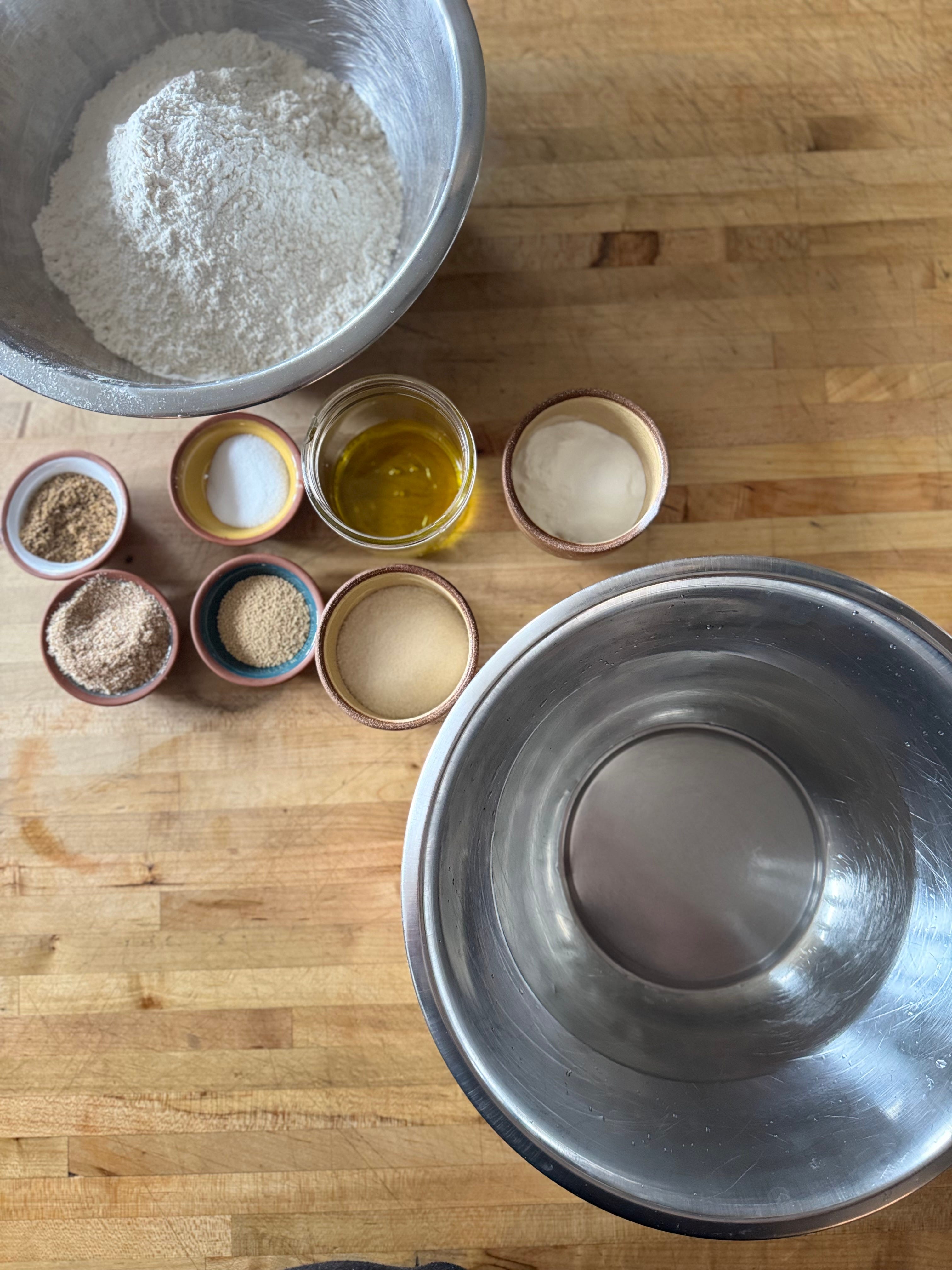
Most home bakers are dependent on recipes.
Professional Bakers use formulas.
Baker’s percentages are the simplest way to understand how ingredients work together so you can tweak, scale, and improve any dough with confidence. It’s the system behind my focaccia, GF breads, sweet rolls, buns, and PIZZAbread.
Learn this once, and your kitchen acumen changes forever.
Formula vs. Recipe
A recipe tells you what to add.
A formula tells you why it works.
In baker’s math, flour is always 100%.
Every other ingredient is expressed as a percentage of the flour weight. This matters because dough doesn’t scale evenly — yeast, sugar, and salt must stay in balance to control rise, texture, and flavor.
A formula keeps that balance no matter the batch size.
Why You Need a Digital Scale
A digital scale is the #1 tool that turns a home cook into a chef.
1. Precision → Understanding
Volume measurements swing wildly.
Grams don’t.
1 ounce = 28 grams. And every cup of flour is different.
Accurate numbers reveal the true ingredient relationships.
2. Consistency → Instinct
Instinct only grows when results repeat.
Once you see what 10g, 20g, or 50g actually do, patterns become obvious — and predictable.
A Simple Example
Ingredient | Weight | Baker’s %
Flour → 500g → 100%
Water → 400g → 80%
Yeast → 10g → 2%
Salt → 12g → 2.4%
Oil → 50g → 10%
Formula:
Ingredient weight ÷ flour weight = baker’s %
Once you know the percentages, you can make this dough bigger, smaller, sweeter, richer, or lighter — without wrecking it.
Salt, Sugar & Yeast: The Key Ranges
Salt
1.5–3% typical
2–2.5% best flavor
Above 4% slows rise + tightens crumb
Sugar
0–5% → savory
5–15% → lightly sweet
15–30% → enriched
Above 30% → over stimulates yeast
Yeast
0.2–1% → long cold rise
1–3% → overnight
1–2% → standard warm-rise
4–5% → fast rolls
Salt slows yeast.
Sugar speeds it.
Balance is everything.
How to Scale Dough (More or Fewer Rolls)
Here’s where baker’s percentages shine:
you can make exactly the amount of dough you want, no guessing.
1. Decide how much total dough you want
If each roll is ~100g and you want 15 rolls:
15 × 100g = 1500g dough
2. Add up your formula percentages
Example:
100% Flour
80% Water
10% Oil
2% Salt
2% Yeast
Total:
194%
Your dough weighs 1.94 × your flour weight.
3. Find your new flour weight
Flour weight = 1500g ÷ 1.94 = 773g flour
4. Multiply flour weight by each %
Using 773g flour:
Water: 618g
Oil: 77g
Salt: 15g
Yeast: 15g
Same dough. Same texture. Just scaled for any number of rolls.
Yo dont just multiply by 2 or 3. You keep the exact same fomula that you know works for 6 buns, to make 15.
Typical Formula % in My Recipes
Classic Focaccia
Hydration 80–95%
Salt 3%
Oil 20%
Sugar 0–5%
Yeast 3-5%
Gluten-Free Focaccia
Hydration 95–120%
Salt 3%
Oil 8–15%
Psyllium/Flax 6–12%
Sugar 1–5%
Yeast 1–2%
Sourdough
Hydration 80–95%
Oil 0-2%
Sugar 0%
Salt ~3%
Yeast 0%
Beyond Bread: How I Use This Everywhere
This isn’t just for dough.
Seasoning mixes
Salt : acid : herbs : sweet : heat — all ratios.
Smoothies
Liquid %, fat %, protein %, fruit %, fiber % — structure creates flavor.
Dressings & sauces
Oil-to-acid ratios make balancing effortless.
Dough variations
Buns, rolls, pizza, GF breads — all start with the same relationships.
Once you understand formulas, you can make any recipe yours without losing structure.
Why It Matters
Learning baker’s percentages + using a digital scale =
the fastest way to level up your cooking.
You’ll be able to:
✔ adjust any recipe
✔ scale dough for any pan or batch
✔ fix mistakes instantly
✔ trust your instincts
✔ understand what’s happening in the bowl
✔ recreate your wins every time
This is the heart of Bake Like a Cook:
Knowledge that supports instinct — not replaces it.